Categories
Barack Obama Domestic issues Economics Financial Crisis History Politics The Opinionsphere

The Value of a Safety Net

Jean Edward Smith points out the obvious yet neglected truth about Franklin Delano Roosevelt’s achievements:

The safety net provided by the New Deal allows time for government to move deliberately.

This is one of the extraordinary things about the legacy of FDR – that even as the nature of the state itself has changed significantly since he was president, the institutions he created still serve some – if not the same purpose – as they did back then.

Today, the safety net created by Roosevelt is an essential stabilizing factor in our society – on the order of regular elections, a civil society, a judiciary, a balance of powers. 

The initial intention of these social safety net programs was consisent with the nation-states of the day, as they competed to see who could provide a minimal standard of living for various at risks groups – such as the elderly and the poor. But today it is far more useful as a stabilizing factor allowing businesses and government officials and individuals adequate time to respond appropriately to financial crises.

Categories
Barack Obama Domestic issues Economics Financial Crisis Health care The Opinionsphere

The Master Plan Always Has Flaws

Daniel Drezner at Foreign Policy summarizes my feelings about Krugman in almost as complete a way as Evan Thomas did:

The fundamental question is whether Krugman is a brilliant hedgehog, an insecure pain in the ass, or – as frequently is the case – both at the same time. 

One suspects that Krugman is at least part right – and that Obama and his team realize this. Obama’s response to the financial crisis has been significant – and more than any government response in history – but it is dwarfed by the scale of the crisis, as Krugman is fond of pointing out. Nicholas Lemann in the New Yorker tries to explain why Obama seems to be ignoring Krugman’s advice so far:

[Obama] has to address the crisis, and he is trying to add enough new controls to the system to prevent a repeat of it, but it looks as if his heart is with the big new programs in his budget and with his foreign-policy initiatives. Bank nationalization would drive the stock market down and increase theagita of people with 401(k) plans. Moderate Democrats in Congress would further soften in their support for the Administration’s legislation. The price of bank nationalization might be Obama’s super-ambitious plans in other realms, which, if history is a guide, are likely to pass only in this first year of his Presidency. If they do pass, he will have generated tax revenues from affluent people for social purposes far beyond those of the House’s tax on A.I.G. bonuses, and he will have significantly eased the distress of people who can’t get good health care or education. That is a lot to put at risk.

At the same time, Obama’s team seems to think that, to quote my post of yesterday:

[I]n the short term, the Geithner plans will work to restart the “old” economy. In this moment before that happens though, pressure from Europe and internal critics as well as a desire to avoid a repeat of this fiasco will enable enough forward-looking, gradualist regulation and legislation to correct the long-term problems with high finance.

E. J. Dionne Jr. in the Washington Post explains where the administration’s focus is:

Obama’s top budget officials seem confident that they can deal with this immediate difficulty. His larger challenge is to take on the politics of evasion promoted by those who would indefinitely delay health-care reform, energy conservation and the expansion of educational opportunities. Already, his lieutenants are signaling how he will cast the choice: between “taking on the country’s long-term challenges” or just “lowering our sights and muddling through,” as one senior aide put it.

If Geithner is responsible for fixing the current crisis, Peter Orszag is responsible for the long-term outlook – of balancing Obama’s plans to expand government’s role and stabilizing our deficit spending. As Jodi Kantor in the New York Times explained:

Mr. Orszag embodies the administration’s awkward fiscal policy positioning: big spending now, with a promise to scrub the budget of waste and a bet that economic recovery and changes to health care will gradually reduce the deficit.

A lot of pieces need to fall together for this to work. I have confidence in each piece of this plan – but together, the venture seems a bit bolder than is wise.

Perhaps this is a perfect moment in history for Obama’s plan – and Obama has the insight to see this; perhaps Obama is a master of politics who is able to get all of these items through; but it’s hard for me not to be discomfited by the manner in which everything is coming together.

Categories
Domestic issues Economics Politics The Web and Technology

Free markets exist not in spite of the government, but because of government.

[digg-reddit-me]One thing many Republicans today do not seem to understand is that the free market is not a natural phenomon. The free market exists not in spite of the government, but because of government.

Reading this white paper by a broadband front group (pdf) which purports to described the “ideology behind net neutrality” which it dubs neutralism and connects it to a lack of respect for private property and an undermining of capitalism, the above sentiment was driven home. As they described the “private property” rights that net neutrality would undermine or take away, it seemed clear to me that they had a fundamental misunderstanding of capitalism – and upon reflection, this fundamental misunderstanding of capitalism seems to have animated a great deal of the perversion of the free market that Republicans ((I use this term although it is a rough one. Some Democrats seem to agree with the Republican points discussed – but they have mainly been associated with the Republican party.)) have promoted for the past thirty years.

The impression one gets from the quasi-libertarian Republican rhetoric of the past two decades is that “government is the problem – not the solution” – and that the free market is the solution. The government and the market are understood to be fundamentally at odds – and so, Republicans have supported a government retreat from any interference in markets. They are in favor of a relaxation of regulations in various areas including from financial industry to the environmental impact of industry; they favor a government that provides as few services as possible – from wanting Social Security privatized to opposing government interference in the health care industry; they want government to allow more mergers and avoid breaking up large companies; they want to reduce taxation; they do not want government to interfere to help labor unions; they oppose rules limiting media ownership; they oppose any laws or regulations enforcing net neutrality.

In short, the Republicans oppose virtually any government “interference” in the free market – and where they cannot plausibly roll back government programs and regulations, they seek to undermine them and to reduce them.

This point of view is often described and justified as a defense of capitalism and free markets – but it truly is an assault on our system of capitalism and free markets in favor of corporate interests. One of the chief roles of the government is the creation of a free market – and many, though not all, of the regulations, programs, and services of the government are designed with this in mind. Sometimes these government interventions do more harm than good – wage and price controls during the New Deal, for example. But the Republican assault on government has not been confined to attacking these harmful programs, but to attacking the role of the government itself.

Many Republicans these days are calling Democratic efforts “socialism,” “Communism,” and “Marxism” – but in reality the Democratic Party has mainly been trying to defend the American economic system which has been under assault since the second of the twin revolutions of late 20th century America. (First was the sexual/cultural revolution of the 1960s that overturned the social and cultural mores; then came the counterrevolution which masked the financial revolution of the 1980s which overturned political and economic values.) They use these broad brushes to attack the very concept that the government has a proper role in a free market – rather than to merely disagree about the effectiveness of certain measures.

The lie to this rhetoric is demonstrated by those limited instances in which Republicans have encouraged government involvement in the marketplace – to extend copyright far beyond its initial scope; to offer tax cuts to favored corporations; to have an extremely large military development budget, etcetera. Each of this policies follows what George Will described as “the supreme law of the land…the principle of concentrated benefits and dispersed costs.” In other words, each of these benefits big corporations rather than helping to maintain a free market.

A society creates a government to establish a process for making and enforcing group decisions. One group decision is to maintain a free market. A free market is not what happens when a government doesn’t interfere – if it was, then the lawless nation of Somalia would have the freest market on earth. Instead, a free market is a nurtured thing, created and shaped by government and society. The creation of a free marketplace in America meant investing in infrastructure and roads to allow for easy transport of goods and people; it meant the regulation of large corporations to ensure they did not become monopolies; it meant creating an independent judiciary to ensure that business disputes could be legitimately settled; it meant a relatively open and transparent government; it meant regulations concerning consumer safety and protection and environmental impact; it meant regulations regarding the stability of the economic system; it meant providing for the basic needs of citizens, especially the elderly, the disabled, and the young; it meant preventing the concentration of too much power; it meant protecting certain rights for minorities and individuals; and more. 

Today, it means protecting net neutrality. Net neutrality is one of the foundational principles of the internet – and as such must be a principle protected by the government. Imagine how our economy would have changed if there were fees required to travel along any roads – fees which could be waived if you were traveling to certain stores. It would reinforce the dominance of large corporations and serve to continue to concentrate power. Imagine if I would have to pay a fee to travel to my local hardware store, but could go for free if I went to Home Depot. Broadband industry advocates insist that not only should consumers pay broadband companies for access to the “roads”, but that websites should also have to pay broadband companies to get their potential viewers there. They propose to undermine and limit the decentralized market that is the internet to favor big companies. 

It is government’s proper role to protect this market – to enforce the rules that have made it such an effective and innovative force. 

The internet has spurred so much innovation because it is a free marketplace. Large corporate interests seek to control and limit this innovation – to ensure their power and profits are not threatened. The Republican party now seems to be going along with these interests. But they should not be allowed to do so under the pretense of protecting “private property” and “free markets.” In reality, their efforts to stop net neutrality are yet another assault on the freedom of the marketplace, another attempt to undermine the American economic system.

Categories
Barack Obama Criticism Domestic issues Politics The Opinionsphere The Web and Technology

Don’t Be Idiots: Stop Talking About the Fairness Doctrine

[digg-reddit-me]

I didn’t think the Democrats were stupid enough to start talking about reimposing the Fairness Doctrine. But I was wrong.

For those not up-to-date with the Fairness Doctrine controversy, it goes back to the late 1960s when the FCC began to push radio and television stations to air material about controversial matters including some consideration for both sides of the issue. ((The Fairness Doctrine was actually created earlier, but it was not incorporated into FCC guidelines until the late 1960s.)) The justification for this government interference was that with a very limited amount of media channels available, and with the airwaves owned by the public and merely licensed to the media companies profiting from them, this was a reasonable request and a necessary one in order to encourage an informed citizenry. By the late 1960s, the powerful corporate forces in the right-wing movement had begun to bankroll a conservative movement at this point – giving enormous amounts of money to create advocacy groups, think tanks, magazines, and other means of pushing conservative messages. One of their goals was to eliminate the Fairness Doctrine – and in 1987 they succeeded. At right about this time with no more obligation to be fair or present both sides of controversial issues, right-wing talk radio took off. Simon Rosenberg publicized this sequence of events – and Steve Rendall at Commons Dreams gives an overview of the liberal take on this history which is worth a read. Since then, conservative talk radio has mobilized the conservative movement – and perpetuated quite a few lies and distrortions. 

In this context, you can see why some Democrats want to bring back the Fairness Doctrine.  After all, if Steve Marlsburg, nemises of this blog, can use the public airwaves to talk for two hours about how Barack Obama is evil and no good people can support him and go on and on supporting this with one lie after another distortion, wouldn’t everyone benefit from a bit of the other side getting a word in edgewise? And if a handful of media titans control almost all of the media, the concentration of power in their hands ensures that opinions they agree with are aired – and oftentimes, that opinions they disagree strongly with are not aired. 

In this context, Bill Clinton mused about reimposing the Fairness Doctrine on a liberal radio show; Democratic Senator Stanbow wants hearings on something like a Fairness Standard; Senator Tom Harken was quoted on another liberal talk radio show saying, “We gotta get the Fairness Doctrine back in law again;” and a number of other Senators and Congressman have similarly suggested something be done to restore “fairness” to the radio. ((It’s worth noting that all of these more recent comments were made by politicians on liberal talk radio – and only after being prompted by their hosts.)) Barack Obama though made it clear during his campaign that he did not support this – and reiterated his opposition again after he took office.

And with good reason: reimposing the Fairness Doctrine might sound like a decent idea given the above history. But there are some major reasons not to:

  1. It won’t accomplish much. Cable and broadcast television shows already give alternative views on controversial issues. They might present one side much better than the other (think Hannity and Colmes) but they give the other side a platform as well. Listeners to conservative talk radio today choose to listen to right-wing nutjobs who don’t try to balance their opinion with facts over more serious sources of news. They have other options if they want them.
  2. It would endanger the important goal of net neutrality. Conservatives are already calling net neutrality a “Fairness Doctrine for the internet.” This is a ridiculous claim – but it will gain some credence if those who support net neutrality also support the Fairness Doctrine. The right continues to push this meme [pdf] and has been having some success in polarizing the support for net neutrality, picking off those right-wingers who are most gullible. As I wrote earlier about this campaign to link these two very different policy ideas
  3. [T]his propaganda campaign [to link net neutrality and the Fairness Doctrine] does not seem directed to the public at large, but at conservative activists. The Fairness Doctrine is not something that gets the blood of the average American boiling. But it does evoke a Pavlovian response among conservative activists and right-wing radio listeners. And although these groups are not large enough to force their way, they are large enough to derail the political conversation and make it harder to enact this obvious policy.

  4. It would also endanger other goals such as breaking up media monopolies. In terms of other issues, Rush Limbaugh in his recent Wall Street Journal op-ed began to lump in rules about “local content” and “diversity of ownership” as the Fairness Doctrine by other means. Rush Limbaugh here is clearly carrying water for Clear Channel Communications who recently gave him a $400 million contract and who would be threatened by rules regarding local content and diversity of ownership as they already own such a large portion of America’s radio stations. Byron York followed Limbaugh’s lead repeating the same talking points in a recent column.
  5. It will provoke a backlash. Right now, aside from the musings of a few prominent liberals and impassioned editorials from liberal talk radio hosts themselves, there is no serious effort to push this idea forward. Liberal ideas are out there – on newspaper editorial pages, on political opinion shows, and most of all on the web. The people most excited by the revival of the Fairness Doctrine are the conservative talk radio hosts and the right-wing movement they lead. I follow this matter closely – reading most articles published on it – and almost every article I read is from some conservative publication or blog hyping the threat to free speech and all that is good and holy that is the Fairness Doctrine. Which is why the Heritage Foundation has this piece of trash written by Rory Cooper insisting that the White House is “rushing” to the Fairness Doctrine – despite the aforementioned opposition by the White House. (A propaganda outlet such as Heritage has not patience for such “subtlties” as facts.) Which is why Senator Inhofe is promoting the view that the Fairness Doctrine as yet another assault on the Christians. Which is why Bryon York recently penned a column linking the Fairness Doctrine to breaking up media monopolies as assaults on “media freedom.” Which is why the World News Daily has distorted Senator Sherrod Brown’s comments to claim he supports the Fairness Doctrine. Which is why Rush Limbaugh and the rest of the talking heads can’t shut up about it. This is a fight the right wants – and for good reason. It plays into the liberal stereotypes conservatives promote – especially the idea of a nanny-state attempt to control free speech. It makes the right look important; it makes the Democrats look petty; if the right loses, they will be able to claim the mantle of victimhood that conservatives seem to relish as much as any other group. 
Categories
Barack Obama Domestic issues Economics Financial Crisis Green Energy Health care Politics The Opinionsphere

The Larger Narrative

[digg-reddit-me]David Brooks:

The crisis was labeled an economic crisis, but it was really a psychological crisis.

Republican pollster David Winston:

[Obama]’s going to have to fit other issues into the larger narrative of the economy.

Michael D. Shear and Paul Kane in the Washington Post:

Whichever side proves to be right, the sharp, partisan lines over the stimulus bill make it plain that both parties intend to exact a political cost over last week’s votes. And their leaders are looking to history for inspiration as they consider how to maneuver in the weeks and months ahead…

Republicans have made it clear that they intend to try to shift the economic debate toward concern about the federal deficit.

Obama is now completing the three-step jig he planned from the beginning, with his address to Congress tonight focused on the Grand Bargain needed to shore up our economy for the forseeable future.

The first step of this jig was supposed to be easy, nonpartisan, and uncontroversial – a spending and tax cutting bill to stimulate the economy. The second step was supposed to be harder but still nonpartisan – dealing with the mortgage and banking messes. In both cases, Obama has approached these problems as a mechanic trying to figure out what has gone wrong and taking whatever steps are necessary to fix it. Just as a mechanic does not make moral judgments about springs and gears but focuses instead on doing what is necessary to get the machine working again, so Obama approached the economy. Most Americans appreciate this, as polls show that while many dislike the specific measures he has had to take, they approve of the job he is doing. The question was: how to get growth started again – greedy bankers and lying loan applicants and wasteful consumers all are being bailed out – because the problems they have caused are “gumming up the works.” And the consumers at least are being encouraged to continue in their spendthrift ways – at least for now, as Dana Milbank explained:

[Ben Bernanke] even indulged in a bit of economist humor when talking about the paradox of encouraging people to spend even though overspending caused the problem: “Somebody once called this the Augustinian principle, which says something like, ‘Let me be moral, but not quite yet.’ “

The third step is more complicated and politically fraught – as Obama seeks to tackle the third-rail of American politics – Social Security; and at the same time, health care reform; and deficit reduction; and tax reform; and possibly climate change legislation. Obama argues that this economic crisis – and the borrowing to stimulate us out of the economic crisis – have created a “fierce urgency of now” – and that all these issues must be tackled at once. 

John Harwood of The New York Times spoke with Senator Judd Gregg about this:

To protect America’s currency and its borrowing capacity, Mr. Gregg said in an interview, “the world has to be told that we’re going to be fiscally disciplined in the out years.”

Efforts to tame long-run entitlement spending may find more Republican support than Mr. Obama achieved on the stimulus. “He has extremely fertile ground in the Senate,” Mr. Gregg said, crediting the president’s early outreach and “courageous position of saying the can’s been kicked down the road long enough.”

Yet despite the bipartisan consensus that these issues must be tackled, here is where the real disagreements should be. Contra George F. Will who argued constantly that the stimulus bill and banking and mortgage bailouts should be opposed by Republicans and supported by Democrats on based their principles, the initial stimulus and other emergency measures should only have raised principled objections from those with an unflagging belief in the free market – which describes only a minority of Republicans. These measures violate the ideologies of both parties – as big business is bailed out and the market is intervened in. There were issues to be raised as to what the most effective methods of dealing with the crisis were – but to oppose measures wholesale as the Republicans did – indicates a lack of seriousness.

The real debate should come now as we decide the shape of things to come and address the moral and political and long-term issues instead of the emergency measures taken to attempt to stimulate the economy.

But in this challenge is an opportunity, as Richard Florida explained in The Atlantic:

The Stanford economist Paul Romer famously said, “A crisis is a terrible thing to waste.” The United States, whatever its flaws, has seldom wasted its crises in the past. On the contrary, it has used them, time and again, to reinvent itself, clearing away the old and making way for the new. Throughout U.S. history, adaptability has been perhaps the best and most quintessential of American attributes. Over the course of the 19th century’s Long Depression, the country remade itself from an agricultural power into an industrial one. After the Great Depression, it discovered a new way of living, working, and producing, which contributed to an unprecedented period of mass prosperity. At critical moments, Americans have always looked forward, not back, and surprised the world with our resilience. Can we do it again?

David Brooks writes with both concern and a carefully measured dose of hope:

[Obama’s] aides are unrolling a rapid string of plans: to create three million jobs, to redesign the health care system, to save the auto industry, to revive the housing industry, to reinvent the energy sector, to revitalize the banks, to reform the schools — and to do it all while cutting the deficit in half.

If ever this kind of domestic revolution were possible, this is the time and these are the people to do it. The crisis demands a large response. The people around Obama are smart and sober. Their plans are bold but seem supple and chastened by a realistic sensibility.

Brooks is still concerned about how this may turn out. As are we all. 

With tonight’s speech, Obama will begin to craete his legacy – beyond fixing the problems accrued during Bush’s tenure. He will begin to, at long last, deal with the stability issues raised by the combination of FDR’s New Deal revision of the social contract and Reagan’s counter-revolution, as he sets a fiscally sane course for the future. In the midst of this crisis, if Obama is to be the leader we need him to be, he needs to see the opportunity to re-write the social contract and create a more stable economic, financial, and international system. Tonight is his chance to make that case. 

Here’s hope it is not wasted.

Categories
Barack Obama Domestic issues Financial Crisis The Opinionsphere Videos

Obama’s Grand Bargain

[digg-reddit-me]From Obama’s Inaugural Address:

There are some who question the scale of our ambitions — who suggest that our system cannot tolerate too many big plans. Their memories are short. For they have forgotten what this country has already done; what free men and women can achieve when imagination is joined to common purpose, and necessity to courage.

What the cynics fail to understand is that the ground has shifted beneath them — that the stale political arguments that have consumed us for so long no longer apply. The question we ask today is not whether our government is too big or too small, but whether it works — whether it helps families find jobs at a decent wage, care they can afford, a retirement that is dignified. Where the answer is yes, we intend to move forward. Where the answer is no, programs will end. And those of us who manage the public’s dollars will be held to account — to spend wisely, reform bad habits, and do our business in the light of day — because only then can we restore the vital trust between a people and their government.

This brings to mind what George Stephanopoulos was so excited about last Sunday on This Week:

(Yes, I need to work on improving my DVR to computer quality.)

It seems that Obama is preparing to bet his presidency on a Grand Bargain – that will allow him (and us) to rewrite the social contract in a more extensive way than any president since Franklin Delano Roosevelt. Even during Obama’s campaign, he spoke of tackling the challenges that were necessary – and not putting off hard discussions about our country’s long-term stability. But the financial crisis – which at first prompted the endlessly parroted conventional wisdom that whoever won would need to cut all of their projects and focus narrowly on the crisis itself – has instead proved to be an opportunity.

The amount of spending needed to stimulate the economy is enormous – with the numbers being thrown around today dwarfing that of any previous government intervention (save perhaps for our major wars). What Obama understands is that this type of spending, while necessary in the short-term, poses a serious long-term threat. Which is why he is now speaking of the second step – after the financial crisis has passed – of tackling entitlement reform and tax reform, and finally putting America on sound financial footing after years of prolifigacy.

None of these insights are exceptional. What is exceptional is how Obama is already shaping the arch of his first term, using this crisis to set up his next objective, and shaping the conventional wisdom.

The problem I see though is that the Obama administration has not done a good job of conveying to the public the place this stimulus bill has within Obama’s agenda. The word is that in the next week or so, Tim Geithner will present “a ‘comprehensive’ plan that [he] hope[s] will command market confidence.” My hope is that this comprehensive plan will lay out a broad legislative agenda based on Obama’s campaign. Based on the campaign plans and signals sent during the transition, here’s what I see:

Step 1 (The First 100 Days)

  • Release the rest of the funds from TARP.
  • A large stimulus package to demonstrate the government’s commitment to addressing the crisis, especially in alleviating it’s effects on the majority of Americans.
  • A banking and mortgage bill that takes whatever steps are necessary to shore up these sectors of the economy, including new regulations, new oversight, and possibly additional funds.
  • An infrastructure bill that would create a National Infrastructure Bank.
  • Health care reforms that would extend health care benefits and attempt to control the escalating health care costs.
  • A combination of a cap-and-trade program and funding for green energy.

The goal of this first period would be to begin to make both short-term and long-term investments into those sectors that will lead to long-term growth – which will stimulate the economy in the short-term. This is the spending stage. After this burst of legislating, Obama would be able to focus on tinkering with education programs and seeing what works, as well as addressing the simmering foreign policy issues which are constantly threatening to take over the agenda.

Step 2 (Post-Crisis)

  • Entitlement reform (Social Security, Medicare, Medicaid.) Everything is on the table.
  • Tax reform. Not much has been said about this. This will certainly be a wild card – but Obama has criticized our corporate tax rate for its irrationality. It’s very high – but due to the enormous number of exemptions and credits, the effective rate for those businesses able to lobby for benefits, it is very low. This should be rationalized.
  • Universal health care.
  • Education reform.

This is the “cutting back” stage and consolidation stage. The goal of this second stage would be to put America on a solid financial footing again – to eliminate the unsustainable domestic policies that undermine our stability and power.

This is obviously an enormous agenda. And it’s far from clear that Obama can accomplish this. But if he does not lay out the vision – which I have pieced together from numerous statements – then it’s hard to see how he can accomplish it. Of course, Geithner was just confirmed last week – and Obama’s only been in office for two weeks – so he does have a bit more time to lay this out. But he doesn’t have long.

Categories
Barack Obama Domestic issues Economics Financial Crisis Politics The Opinionsphere

Fair-Minded Yglesias

Matt Yglesias points out the inconsistency in Republican opponents of the stimulus bill claiming:

we can’t afford large new temporary deficit spending but can afford large new permanent tax cuts.

And then Yglesias points to “a Republican worth listening to,” Rep. John L. Mica.

It’s the fair-mindedness that keeps me reading Yglesias’s stuff.

Categories
Barack Obama Domestic issues Economics Financial Crisis The Bush Legacy The Opinionsphere

Galvanized By Sexual Panic

Andrew Sullivan on the big headline GOP objections to the stimulus bill (Funding for Contraception! Funding for STD Prevention!)L

[W]hy is it the GOP is so easily galvanized by sexual panic? Weird, if you ask me. This is the budget we’re talking about here. Even there, they reach, like the exhausted tacticians they are, for the culture war.

Categories
Domestic issues Economics Energy Independence Financial Crisis Green Energy Humor Politics The Opinionsphere

Eliot Spitzer v. Sarah Connor

Eliot Spitzer has some good ideas about how to spend the stimulus money, including this technology which I’d heard of but not understood until reading:

[Smart meters] would permit, with a smart grid, time-of-day pricing for all consumers, with potentially double-digit reductions in peak demand, significant cost savings, and consequential remarkable energy and environmental impacts. These declines in peak demand would translate into dramatic reduction in the number of new power plants. The problem with installation of smart meters has been both the cost and, often, state-by-state regulatory hurdles. Now is the moment to sweep both aside and transform our entire electricity market into a smart market.

However, Spitzer has another more controversial proposal which Matt Yglesias fears will lead to the end of the human race, “Provide funding for robotics teams at every school. Yglesias:

After the human race is enslaved by robots, there are going to be small rebel groups hiding out somewhere and Elliot Spitzer’s going to be writing op-eds about how “no one could have predicted” that the robots would rebel and overthrow their masters. And it’ll be left to DFH bloggers to observe that this is in fact one of the most widely predicted scenarios in all of science fiction. From the proto-SF of Mary Shelly’s Frankenstein through to Karel Capek’s R.U.R. and The War Against the Newts all the way up through Terminator and The Matrix. Yes, yes, yes eventually the Butlerian Jihad will allow us to re-overthrow the Thinking Machines and establish human rule but do we really want to fall into that trap?

Just say no to robots. And certainly say no to robots in our schools.

You just know that Spitzer – for promoting this idea – would be on Sarah Connor’s hitlist.

Categories
Barack Obama Domestic issues Politics

Distractions

[digg-reddit-me]

The Bush administration has been praised often for doing their part to ensure a smooth transition to an Obama presidency. At the same time, many leading Republicans have said that they – like the rest of the country – are rooting for Obama to succeed. The consequences of him failing, especially on the economic front, are just too dire.

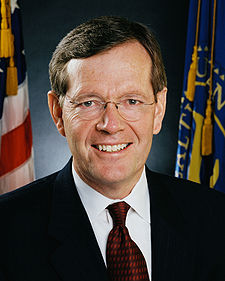
Yet, someone in the Bush administration hasn’t gotten the message. Secretary of Health and Human Services Michael Leavitt recently instituted a new regulation expanding the right of various health care workers to refuse to refer a woman to an abortion provider, to refer a woman to any service that might counsel an abortion, or to provide emergency contraception.

This regulation is set to take effect on Obama’s inaguration day. Leavitt could hardly think that such a regulation would survive past the inaguration of a pro-choice president. And for some reason, he had not instituted the regulation before this point despite being secretary since 2005 – so he obviously didn’t see it as a priority.

But it’s hard to think of a better way to drag Obama into the culture wars and reduce his political capital as he attempts to tackle our looming economic crisis.

[This picture is a work of the U.S. Federal government and thus part of the public domain.]